Lionfish Predators: What Eats Lionfish in the Wild?
One of the first questions people ask when they learn about the lionfish invasion is: why can’t natural predators just take care of them? It’s a sensible question. Nature is full of predator-prey relationships that maintain balance, so why should lionfish be any different?
The honest answer is complicated, humbling, and ultimately explains why diver-led removal programs like the ones Roger J. Muller Jr. champions at LionfishDivers.com remain the most effective tool we have. Natural predation has not controlled lionfish in the Atlantic and probably cannot do so on any timeline that matters for reef health.
The Predator Problem in the Atlantic
In the Indo-Pacific, where lionfish evolved, they exist within a complex web of predator-prey relationships built over millions of years of co-evolution. Larger predators, including moray eels, large grouper, sharks, and others, have learned that lionfish, despite their venomous spines, are edible. The venom is a deterrent, not an absolute barrier, and Indo-Pacific predators have developed the technique of stunning or manipulating lionfish in ways that avoid the spines.
In the Atlantic, Caribbean, and Gulf of Mexico, no such co-evolutionary history exists. Atlantic predators encounter lionfish as a completely novel animal; one they have no instinctive behavioral playbook for. The spines are an effective deterrent to animals that have never learned to work around them. The result: lionfish in the Atlantic experience virtually no natural predation pressure.
Known Lionfish Predators in Their Native Indo-Pacific Range
In their home waters, lionfish are preyed upon by a range of large, powerful predators that have evolved the behavioral repertoire to handle venomous prey:
- Large grouper species: Including the coral grouper and giant grouper, both of which have been observed consuming lionfish in the Indo-Pacific.
- Moray eels: Their flexible, muscular bodies allow them to approach and consume lionfish from angles that minimize spine contact.
- Large scorpionfish: Which shares enough of the lionfish’s biological profile that they can interact with them safely.
- Sharks: Various species, including whitetip reef sharks, have been observed to consume lionfish, though not as a dietary staple.
Predators That Eat Lionfish in the Atlantic
Here’s where things get genuinely interesting. While Atlantic predators do not routinely hunt lionfish as prey, documented predation does occur, and in some cases, predators appear to be learning. Confirmed Atlantic lionfish predators include:
- Large grouper (Nassau grouper, goliath grouper): The most documented Atlantic lionfish predators. Nassau grouper in particular has been observed consuming lionfish, and some researchers have suggested that targeted grouper conservation could contribute indirectly to lionfish control.
- Large moray eels: Some eels have been observed interacting with and occasionally consuming speared or distressed lionfish, suggesting capacity for adaptation.
- Sharks: Nurse sharks and blacktip sharks have rarely been observed consuming lionfish, though this is not a regular behavior.
- Dolphins and large predatory fish: Anecdotal reports exist, but documented evidence is limited.
Why Predation Alone Cannot Control the Invasion
Even with the documented predation above, natural predator control of lionfish in the Atlantic is not a realistic near-term solution for several critical reasons. First, Atlantic predator populations, especially large groupers, have themselves been severely depleted by decades of overfishing. The predators that might potentially learn to hunt lionfish are far too rare to apply meaningful population pressure.
Second, the learning curve is slow. Behavioral evolution occurs over generations, and lionfish populations are growing far faster than any potential learning curve in Atlantic predators. Third, lionfish reproduce at extraordinary rates of up to 30,000 eggs every four days per female, meaning that even substantial predation pressure would need to be enormous to make a dent.
Humans: The Most Effective Lionfish Predator
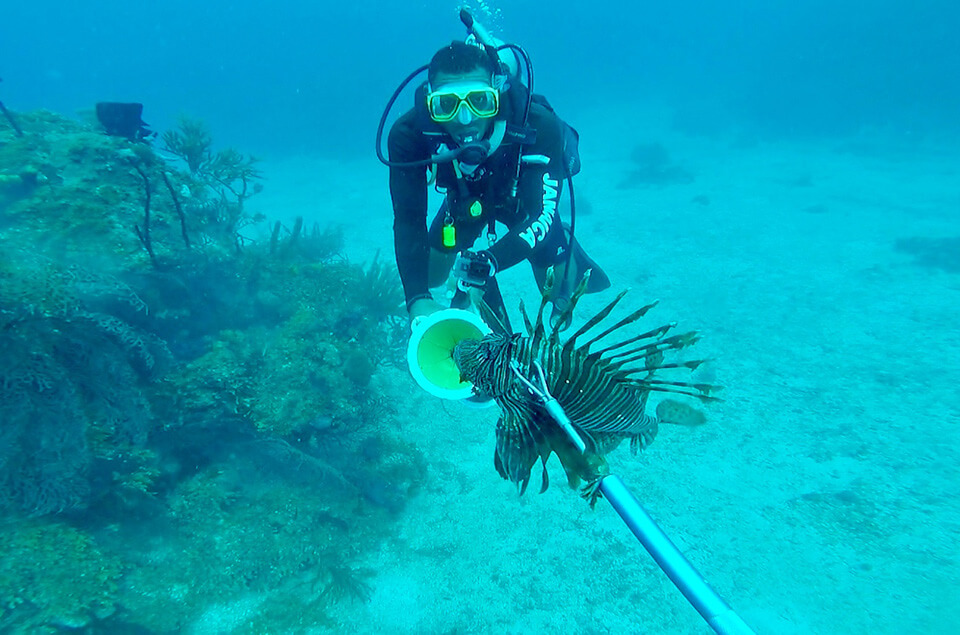
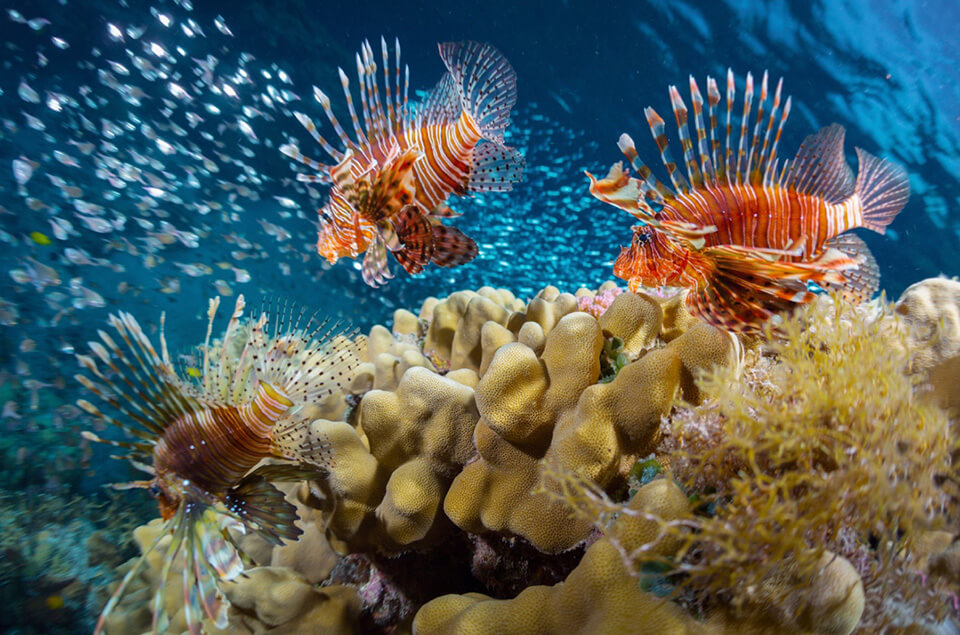
The conclusion that science consistently reaches is both sobering and empowering: the most effective lionfish predator in the Atlantic is a scuba diver with a pole spear. Human hunters can target and remove lionfish at a rate and scale that no natural predator can currently match, and organized removal programs have demonstrated real, measurable reductions in lionfish density on actively hunted reefs.
This is why Roger J. Muller Jr. and LionfishDivers.com continue to emphasize diver education and certification. Every certified hunter who joins the water is adding to the only predation pressure on Atlantic lionfish that is currently capable of making a difference. Get certified. Get in the water. Be the predator the reef needs.
For more about lionfish education, SSI certifications, hunting expeditions, and cooking, visit LionfishDivers.com and learn about Roger’s upcoming SSI Lionfish Awareness Distinctive Specialty certification program.