Student Spotlight: Cal Kennedy Brings Lionfish Awareness to Nebraska
Student Spotlight: Cal Kennedy Brings Lionfish Awareness to Nebraska
At LionfishDivers.com, we are always looking for people who push the lionfish conversation beyond the reef. Sometimes that work happens underwater. Sometimes it happens in classrooms, galleries, and places where lionfish are almost impossible to encounter firsthand.
Cal Kennedy did exactly that.
As a senior graphic design student at the University of Nebraska Lincoln, Cal created an ambitious capstone project centered entirely on invasive lionfish.
When we asked Cal why he chose to focus his capstone project on lionfish, in Nebraska of all places, he explained, “A lot of people get out of Nebraska on vacation. I am hoping this leaves a mark on them for when there is a potential for lionfish to be on the menu while they are traveling.”
A Capstone That Went Beyond Expectations
Cal finished his Graphic Design Capstone course with a A, an achievement that reflects both the quality and ambition of the work. The project earned top recognition within the program and stood out as one of the most complex student builds in the exhibition.
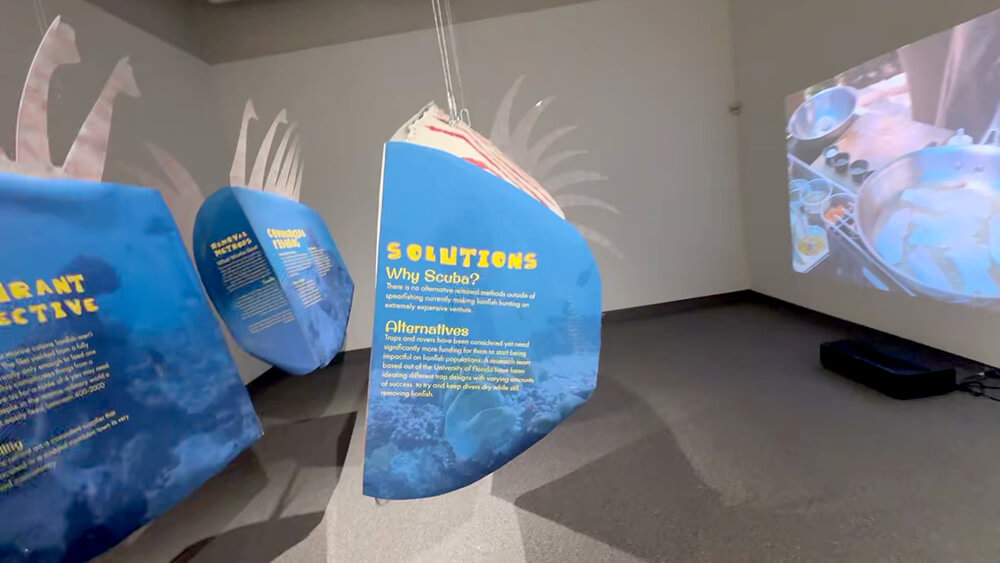
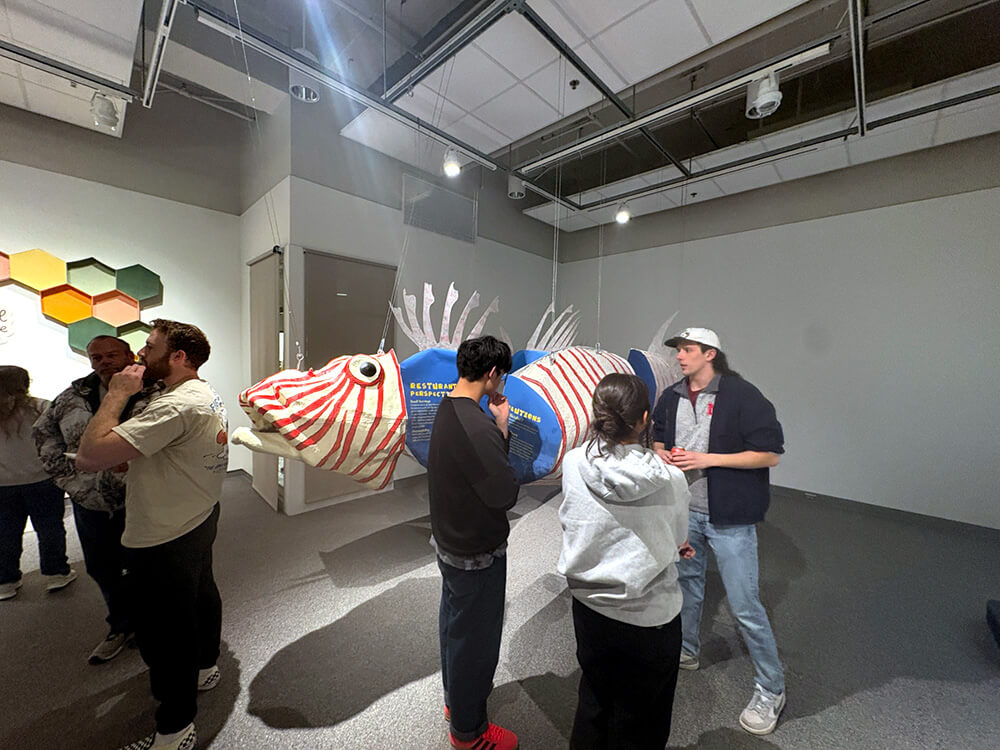
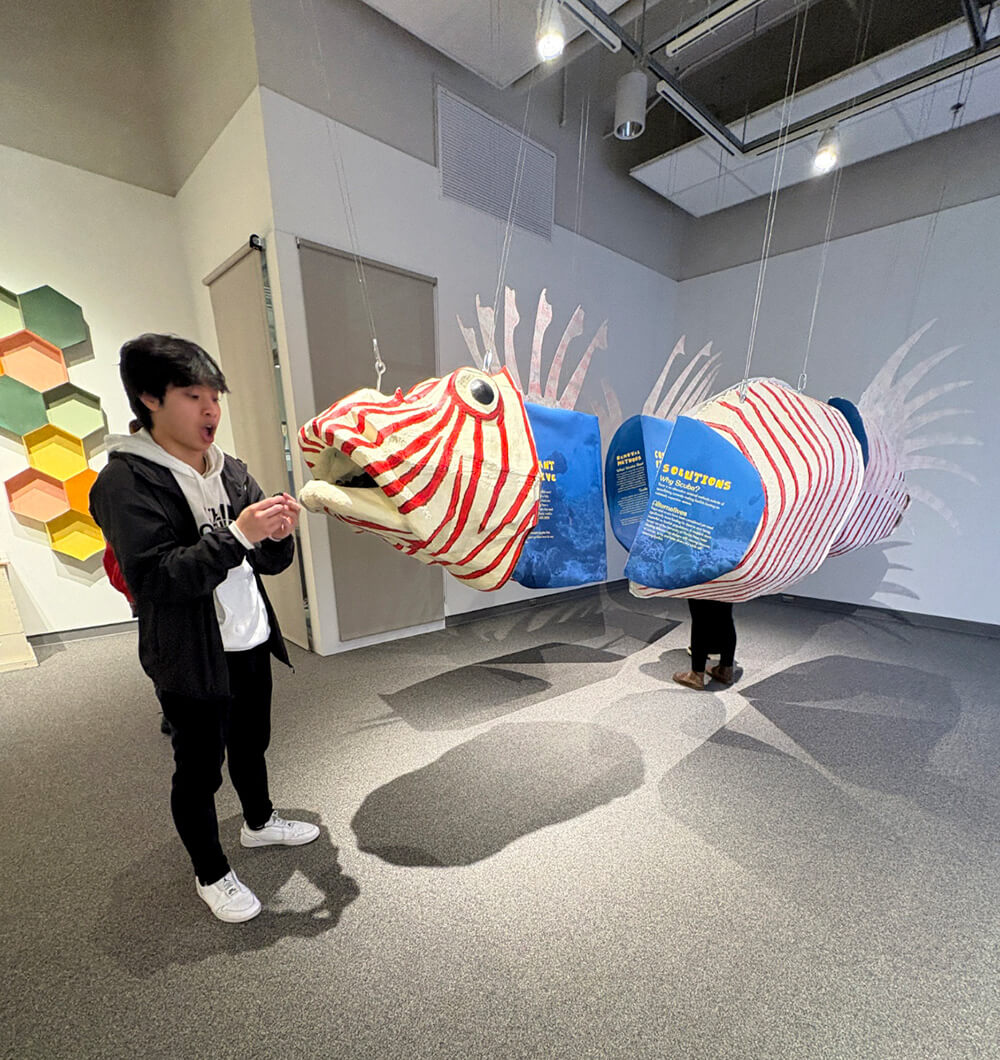
The capstone combined multiple disciplines including graphic design, video production, fabrication, and interactive education. The final installation consisted of a large scale sculptural lionfish display, a short documentary film, and supporting digital content designed to work together as a single educational experience.
Rather than creating something purely visual, Cal wanted the project to function like a science museum exhibit. Interactive, playful, and grounded in real information. The goal was to make learning about lionfish unavoidable, even for people who had never heard of them before.
Why Lionfish in Nebraska
Lionfish are not native to the Atlantic and Caribbean reefs they now dominate. They are invasive, destructive, and devastating to local ecosystems. Yet in Nebraska, they are nearly invisible.
“In Nebraska, the only place you can really see a lionfish is the Omaha Zoo,” Cal said. “That makes it hard for people to care about something they never encounter.”
That challenge became the foundation of the project. By placing a hyper realistic lionfish sculpture in a gallery space, Cal brought the problem directly to an audience that would otherwise never engage with it.
The intention was not shock, but awareness. Cal wanted viewers to walk away remembering the fish, remembering the issue, and thinking about it later when it mattered.
Especially on vacation.
Built With Ingenuity and Purpose
Originally, Cal envisioned a professionally fabricated sculptural piece. After speaking with fabrication agencies, it quickly became clear that the cost was far beyond a student budget. Instead of scaling back, he rebuilt the plan from the ground up.
The display body was constructed using recycled foamcore board from previous capstone exhibits. Layers of paper mache and acrylic paint were used to shape and finish the form. For the focal point, Cal 3D printed the lionfish head in 29 separate pieces using a collection of Prusa MK4 printers, then assembled and finished it to achieve the realism he wanted.
The result was a striking centerpiece that drew people into the space and held their attention.
Telling the Story Beneath the Surface
Alongside the physical exhibit, Cal produced a documentary film that focused on the people actively involved in lionfish removal and utilization. The film featured interviews with divers, innovators, and seafood professionals who are working to turn an environmental crisis into a solution.
By highlighting collaboration between dive operators, product developers, and restaurants, the film reinforced a key message shared by LionfishDivers.com. Removing lionfish from reefs and putting them on the table is one of the most effective tools available to restore balance to affected ecosystems.
The documentary grounded the gallery experience in real world action and showed viewers that this issue is being addressed every day by people who care deeply about the ocean.
A Personal Connection to the Water
Outside the classroom, Cal spends his summers working underwater for a marine services company, cleaning and maintaining submerged structures. That experience gave him a strong appreciation for marine environments and life below the surface.
Whenever he gets the chance, Cal also scuba dives recreationally in Florida, further deepening his connection to the ocean and the ecosystems impacted by invasive species.
When asked where he would most like to dive next, his answer was simple.
“Belize.”
Why This Matters to LionfishDivers.com
Lionfish removal depends on awareness just as much as action. Cal Kennedy’s project proves that education does not need to happen near a reef to be effective. It can happen in the middle of the country, in a gallery, through design, storytelling, and curiosity.
By reaching people before they ever see a lionfish on a reef or a menu, projects like this help change how the public understands and responds to the issue.
We are proud to spotlight Cal and his work. His project is a reminder that the fight against invasive lionfish needs designers, educators, and storytellers just as much as it needs divers.
And sometimes, the most important conversations start far from the ocean.